Nearly one in three UK property transactions involves a post-survey renegotiation — yet most buyers never question whether their original report told the full story. The decision to seek independent second opinions after a buyer's survey is one of the most financially significant choices a homebuyer can make, and in 2026, with repair costs at record highs and lender valuations offering buyers almost no protection, getting a fresh building survey at the right moment can save tens of thousands of pounds — or prevent a catastrophic purchase altogether.
This guide explains exactly when independent second opinions after a buyer's survey are worth the cost, how to brief a second surveyor effectively, and what to look for when the stakes are high.
Key Takeaways 📋
- A lender's valuation is not a condition survey — it protects the bank, not the buyer. If that is your only report, a fresh building survey is almost always justified.
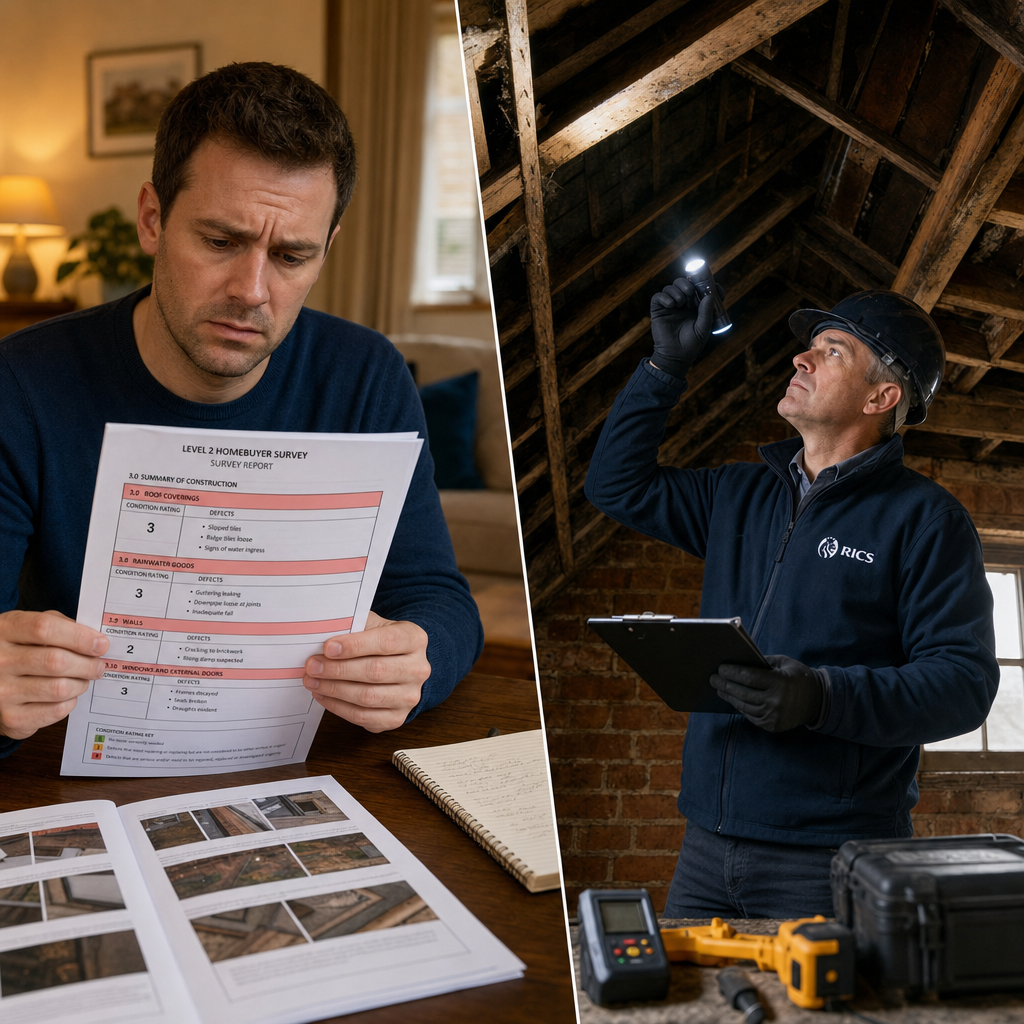
- "Further investigation recommended" is not a minor caveat — it is a professional signal that the issue exceeds the surveyor's scope or confidence level.
- A Level 3 (Full Building Survey) from an independent surveyor is most cost-effective on older, altered, or non-standard properties where a Level 2 may have missed critical defects.
- Briefing the second surveyor correctly avoids duplicated work and focuses attention on the disputed or unclear findings.
- Second opinion surveys frequently pay for themselves through price renegotiation, especially when backed by costed repair schedules.
Why the First Survey May Not Be Enough
Most buyers commission a survey believing it will provide a comprehensive picture of a property's condition. In reality, the level of protection depends heavily on which type of survey was chosen — and many buyers choose the cheapest option available.
The Limits of Lender Valuations and Level 2 Surveys
A mortgage valuation is commissioned by the lender, not the buyer. Its purpose is to confirm the property is suitable security for the loan. As the FCA has made clear, this report is primarily for the lender's benefit — and the lender is not liable if defects are later discovered. Buyers who rely solely on a mortgage valuation have virtually no recourse if serious problems emerge after completion.
A Level 2 Homebuyer Survey (RICS Home Survey Level 2) is a step up, providing a visual inspection and condition ratings. However, it is a non-intrusive survey — surveyors do not lift floorboards, move furniture, or access roof spaces beyond a hatch. On older, extensively altered, or structurally complex properties, a Level 2 can miss significant defects simply because they are not visible during a standard walkthrough.
💬 "The lender's valuation tells you what the bank thinks the property is worth. It does not tell you what it will cost to keep it standing."
For a full comparison of survey types and what each level covers, see this guide to comparing different types of survey.
When "Further Investigation Recommended" Is a Red Flag
Since 2022, RICS surveyors have increasingly included "further investigation recommended" clauses in their reports. This is partly driven by professional indemnity pressures — surveyors are cautious about making definitive diagnoses for issues outside their core expertise, such as complex structural movement, specialist damp analysis, or cladding fire safety.
When a report uses this language, it is not a minor caveat. It is a professional signal that:
- The issue may be more serious than a visual inspection can confirm
- The surveyor lacks the specialist knowledge to assess it fully
- The buyer needs additional expert input before committing
Common triggers for "further investigation" clauses include:
| Issue Flagged | Specialist Typically Required |
|---|---|
| Suspected subsidence or structural cracking | Structural engineer |
| Damp, rising damp, or wet/dry rot | PCA-registered damp/timber specialist |
| Roof condition concerns | Roofing contractor or specialist roof surveyor |
| Japanese knotweed | Invasive species specialist |
| Cladding or fire safety concerns | Façade engineer or fire safety consultant |
| Drainage or drainage-related movement | Drainage engineer |
Independent Second Opinions After a Buyer's Survey: When a Fresh Building Survey Is Worth the Cost
Not every buyer needs a second survey. The decision should be driven by the nature of the property, the scope of the original report, and the financial risk involved. Below are the clearest scenarios where commissioning an independent second opinion is not just advisable — it is essential.
Scenario 1: The Property Is Old, Altered, or Non-Standard
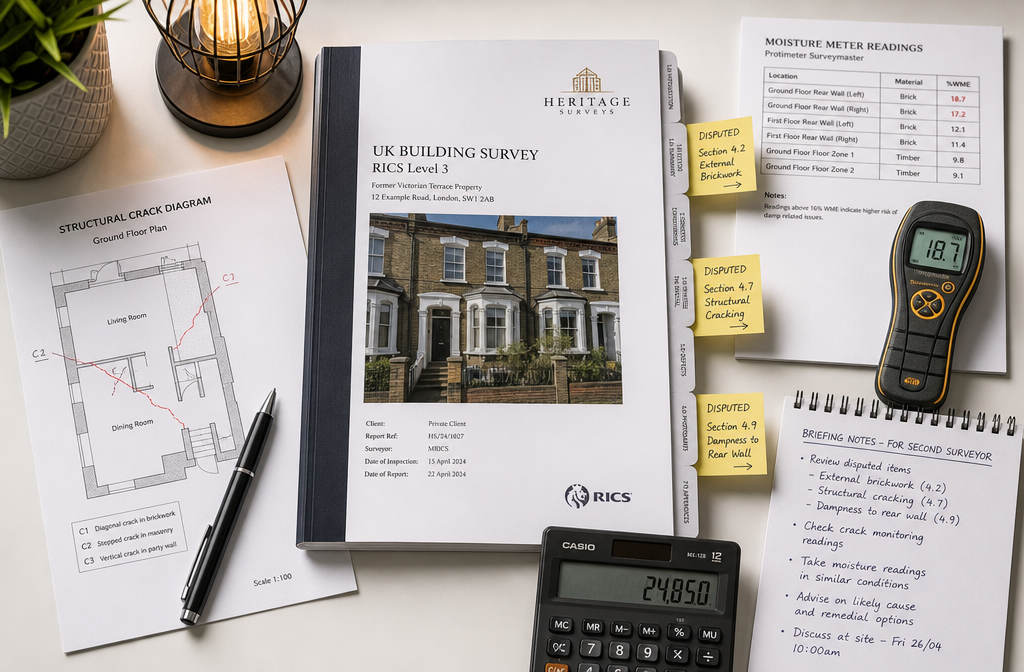
RICS guidance is explicit: a Level 3 Full Building Survey is designed for "larger, older or run-down properties, buildings that are unusual or have been significantly altered." If an initial Level 2 was commissioned on a pre-1900 Victorian terrace, a converted barn, or a property with a flat roof extension and loft conversion, the original report may not have gone deep enough.
A RICS Level 3 Building Survey provides a more intrusive inspection, detailed analysis of construction methods, and specific advice on repair liability — information that can fundamentally change a buyer's negotiation position or decision to proceed.
The cost-benefit case is straightforward:
- Level 3 survey cost: typically £600–£1,500 depending on property size and location
- Potential repair liabilities if missed: roof replacement (£5,000–£20,000+), underpinning (£10,000–£50,000+), damp remediation (£2,000–£10,000+)
- A second survey that identifies even one significant defect typically pays for itself many times over
Scenario 2: Disputed Defect Significance
One of the most common and underappreciated reasons for seeking an independent second opinion is disagreement about the severity of a flagged defect. Sellers frequently commission their own contractor reports after a buyer raises survey concerns — and those reports often minimise the problem.
When a seller's roofer says "minor maintenance needed" and the buyer's surveyor says "significant deterioration," the buyer needs independent, costed evidence to negotiate effectively. A second opinion from a specialist — or a full RICS building survey — provides that evidence in a form that is credible to both parties and, if necessary, to a court.
💡 Pro Tip: When commissioning a second opinion specifically to dispute a seller's contractor report, ask the second surveyor to provide a costed schedule of works. This transforms a qualitative disagreement into a quantifiable negotiation figure.
Scenario 3: Leasehold Flats and Shared Buildings
Leasehold properties present a unique second-opinion challenge. A buyer's survey on a flat typically covers only the interior of the individual unit — it does not assess the structural condition of the building as a whole, the roof, or the common parts. Yet it is those shared elements that can generate the largest unexpected bills through service charges and Section 20 major works notices.
If a Level 2 survey on a leasehold flat hints at water ingress to common parts, historic movement in the structure, or potential cladding concerns, commissioning an independent inspection of the wider building — or at minimum a review of the management company's reserve fund and outstanding Section 20 notices — is strongly advisable.
For flats in mid- and high-rise blocks, the post-Grenfell Building Safety Act regime has made this even more critical. Where EWS1 documentation is missing, incomplete, or more than a few years old, buyers should seek updated independent assessments before exchange, as remediation liabilities can run to six figures and affect resaleability.
Scenario 4: Subsidence, Structural Movement, or Foundation Concerns
Visible cracking, sloping floors, or doors and windows that stick are among the most anxiety-inducing survey findings — and among the most misunderstood. Not all cracking indicates active subsidence; some is purely cosmetic. But distinguishing between the two requires specialist knowledge that goes beyond a standard building survey.
A subsidence survey or structural engineer's report is the appropriate second opinion in these cases. These specialists can assess crack patterns, monitor movement over time, and provide a definitive view on whether underpinning or other structural intervention is required. Given that underpinning costs can exceed £30,000, this is not a risk worth taking on the basis of a caveated Level 2 report.
Scenario 5: New Builds and Recently Converted Properties
New-build buyers often assume that a developer's handover inspection or NHBC warranty provides adequate protection. In practice, independent snagging surveys consistently identify defects that developer inspections miss — from poor insulation installation to drainage issues and structural deficiencies.
The New Homes Quality Board and consumer groups recommend independent snagging inspections before legal completion, while access to the property is still possible and while the developer's repair obligations are clearly enforceable. Timely, independent evidence is crucial to enforcing warranty claims.
How to Brief a Second Surveyor to Avoid Duplication
Commissioning a second survey without a clear brief risks paying for a generic report that simply repeats what the first surveyor found — or misses the specific issues that triggered the second opinion in the first place.
Step-by-Step Briefing Process
1. Share the original report (with permission)
Most second surveyors will want to review the first report before inspection. This allows them to focus on disputed or unclear findings rather than starting from scratch.
2. Identify the specific concerns
List the exact clauses, condition ratings, or "further investigation" recommendations from the original report. Be specific: "Condition Rating 3 on rear elevation brickwork — surveyor uncertain whether this is active or historic movement."
3. Request a costed schedule of works
If the purpose of the second opinion is negotiation, ask explicitly for a schedule of works with estimated costs. This is the most commercially useful output.
4. Clarify the scope
Specify whether the second surveyor should:
- Conduct a full Level 3 inspection of the entire property
- Focus only on specific defects flagged in the first report
- Provide a specialist report (e.g., structural, damp, roofing)
5. Confirm independence
Ensure the second surveyor has no connection to the seller, the estate agent, or the original surveyor. For RICS-regulated surveyors, this is a professional requirement — but it is worth confirming explicitly.
For buyers in the Manchester area and beyond, understanding why choosing an RICS Chartered Building Surveyor matters is an important first step in selecting the right professional for a second opinion.
Independent Second Opinions After a Buyer's Survey: Using the Report to Renegotiate
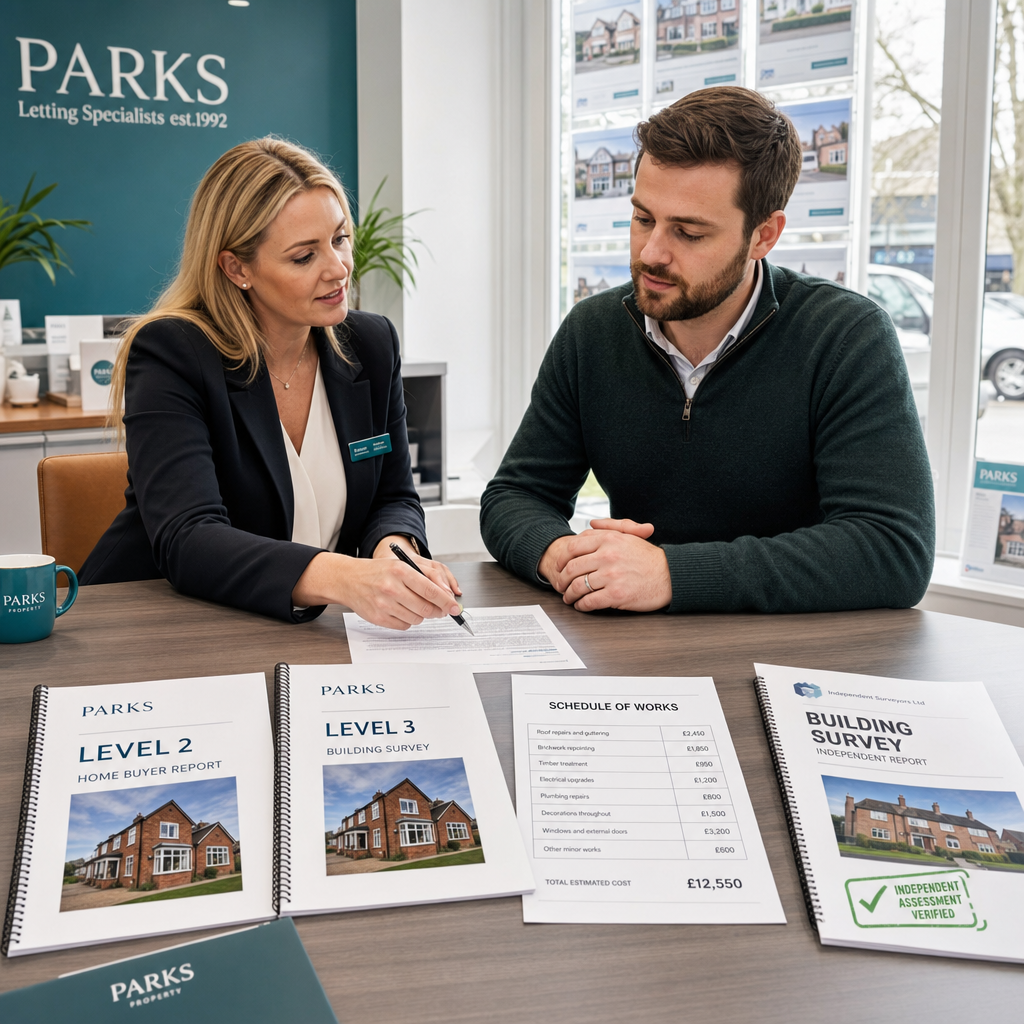
A well-commissioned second opinion survey is not just a risk management tool — it is a negotiation asset. Industry data consistently shows that buyers who present independent, costed evidence when requesting price reductions are significantly more successful than those who rely on vague references to survey concerns.
Making the Case for a Price Reduction
When approaching a seller with a price reduction request based on survey findings, the following structure is most effective:
- Present the independent report — not a summary, the full document from a named, RICS-qualified surveyor
- Attach the costed schedule of works — specific line items with market-rate estimates
- Frame the request proportionately — ask for a reduction equivalent to the estimated repair cost, not a speculative figure
- Set a clear deadline — give the seller a reasonable timeframe to respond, typically 5–7 working days
💬 "Sellers respond to evidence, not anxiety. A second surveyor's report with a £12,000 repair schedule is a negotiating tool. A vague reference to 'damp concerns' is not."
When to Walk Away
Sometimes the most valuable outcome of an independent second opinion is the clarity to walk away. If a second survey reveals that repair liabilities significantly exceed what was anticipated — or that the property has structural, safety, or legal issues that the seller cannot or will not address — exiting before exchange is far less costly than discovering these problems after completion.
For buyers considering whether a specific defect survey might be more appropriate than a full second survey, this targeted approach can be highly cost-effective when the concern is limited to one or two well-defined issues.
The Cost-Benefit Summary 💰
| Scenario | Second Opinion Cost | Potential Saving or Risk Avoided |
|---|---|---|
| Level 3 survey on pre-1900 property | £600–£1,500 | £5,000–£50,000+ in missed defects |
| Structural engineer on cracking | £300–£800 | £10,000–£50,000+ underpinning costs |
| Damp/timber specialist report | £200–£500 | £2,000–£10,000+ remediation costs |
| Leasehold building inspection | £400–£900 | £10,000–£100,000+ in future service charges |
| Snagging survey (new build) | £300–£600 | Enforced developer repairs before completion |
For buyers uncertain about which type of assessment best fits their situation, a RICS Home Survey overview can help clarify the options and their respective scopes.
Conclusion: Actionable Next Steps
Independent second opinions after a buyer's survey are not a sign of distrust in the original surveyor — they are a rational response to the financial scale of a property purchase and the inherent limitations of any single inspection.
Here is what to do if a buyer's survey has raised concerns:
✅ Read the report carefully — identify every "further investigation recommended" clause and every Condition Rating 3 item.
✅ Assess the property type — if it is pre-1900, non-standard construction, or heavily altered, a Level 3 survey from an independent surveyor is almost always justified.
✅ Match the second opinion to the specific risk — structural concerns need a structural engineer; damp needs a PCA-registered specialist; roof concerns need a specialist roof survey.
✅ Brief the second surveyor in writing — share the original report, list specific concerns, and request a costed schedule of works.
✅ Use the report as a negotiation tool — present independent, costed evidence when requesting a price reduction or asking the seller to complete repairs before exchange.
✅ Be prepared to walk away — if the second survey reveals liabilities that fundamentally change the value proposition, exiting before exchange is the financially sound decision.
In 2026's property market, where repair costs are elevated and buyer protections remain limited, the cost of a second opinion is almost always dwarfed by the cost of getting it wrong.
References
[1] Buyers Eye 2026 As The Year To Make Their Move – https://www.realestatenews.com/2025/12/09/buyers-eye-2026-as-the-year-to-make-their-move
[8] Buyer Pulled Out How Is This Process Allowed In – https://www.reddit.com/r/HousingUK/comments/1qnjfr2/buyer_pulled_out_how_is_this_process_allowed_in/