Nearly one in five planning objections submitted to UK local authorities cite overlooking, loss of privacy, or overbearing impact as the primary concern — yet the majority of these disputes never reach a formal hearing. They fester between neighbours, escalate into legal threats, and in many cases, end up costing far more in professional fees and damaged relationships than the original extension ever cost to build.
Neighbour disputes over extensions and overlooking: when a building surveyor's report can help resolve planning and amenity concerns is not simply an academic question. It is a practical challenge faced by thousands of UK homeowners every year — both those building extensions and those living next door to them. Understanding how a qualified building surveyor fits into this process — providing objective technical evidence that sits alongside (not instead of) planning and party wall procedures — can mean the difference between a swift resolution and years of costly conflict [7].
Key Takeaways 📋
- Building surveyor reports provide technical evidence on overshadowing, overlooking, structural impact, and rights to light — evidence that planners, solicitors, and mediators can all use.
- Planning law, the Party Wall etc. Act 1996, and private rights (such as right to light) are three separate legal frameworks — a surveyor's report can support all three without duplicating them.
- Early professional involvement almost always reduces costs and speeds up resolution.
- An independent, RICS-accredited surveyor carries far greater weight with planning authorities and courts than informal assessments.
- Not every dispute requires litigation — a well-prepared surveyor's report often prompts negotiated solutions before formal proceedings begin.
Understanding the Legal Landscape: Three Frameworks, One Dispute
When a neighbour builds an extension — whether a rear single-storey addition, a side return, or a two-storey structure — the concerns raised by affected neighbours typically fall into three overlapping legal categories. Knowing which framework applies to which concern is the first step toward resolution.
1. Planning Law and Material Considerations
Under the UK's planning system, local planning authorities (LPAs) assess proposed extensions against their Local Plan policies. Overlooking, loss of privacy, overshadowing, and overbearing impact are all recognised as material planning considerations [2]. This means a neighbour can formally object to a planning application on these grounds, and the LPA must weigh those objections.
However, planning permission does not guarantee that a built extension is acceptable in every respect. Extensions built under Permitted Development (PD) rights — which allow certain works without a full planning application — can still cause genuine amenity harm to neighbours, even though no formal objection process exists [6].
💡 Key point: Planning approval (or permitted development) does not extinguish a neighbour's right to seek independent technical evidence about the impact of an extension on their property.
2. The Party Wall etc. Act 1996
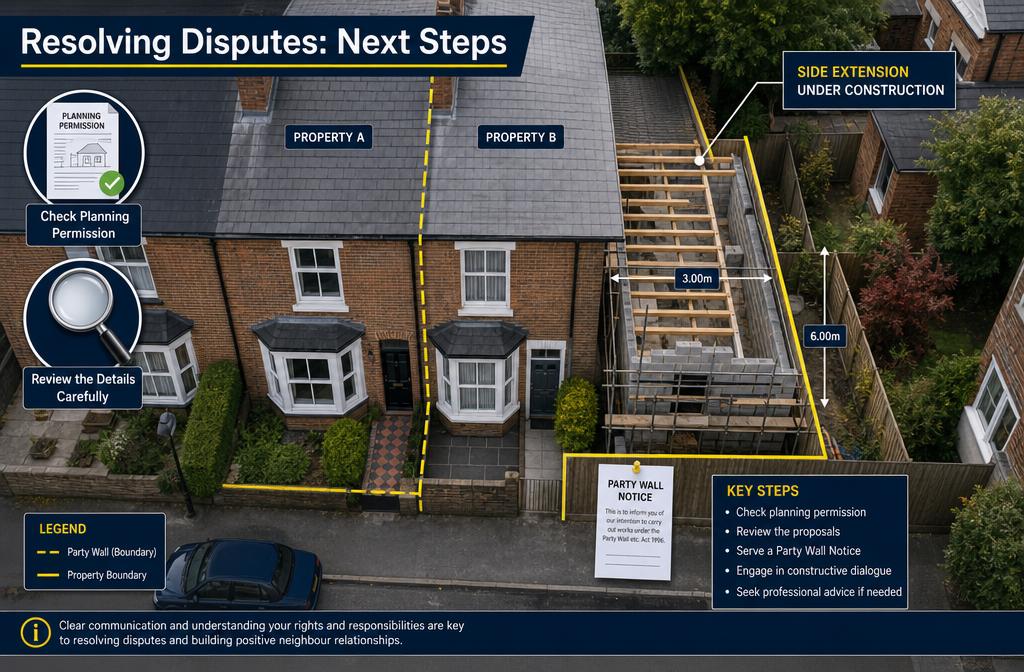
Where an extension involves work on or near a shared boundary — including excavations within 3–6 metres of a neighbour's foundations — the Party Wall etc. Act 1996 applies. This legislation requires the building owner to serve formal notices, and if the neighbour dissents, both parties appoint surveyors to agree an Award [1].
For a detailed explanation of what happens when disputes arise under this legislation, see what is a party wall dispute — a useful primer for anyone receiving or serving a party wall notice.
It is important to understand that the Party Wall Act governs structural and boundary works, not planning amenity concerns. A party wall surveyor's role is distinct from that of a building surveyor preparing an amenity impact report.
3. Private Rights: Right to Light
Separately from planning law, a property may hold a legal right to light — an easement acquired after 20 years of uninterrupted natural light passing through a defined aperture (typically a window). If a neighbour's extension substantially interferes with that right, the affected party may have grounds for an injunction or damages in civil law [4].
RICS has published guidance confirming that rights to light disputes are increasingly common as urban densification increases [4]. Critically, this is a private law matter — the planning system does not protect or override it.
What a Building Surveyor's Report Actually Covers
This is where many homeowners become confused. A building surveyor's report in the context of neighbour disputes is not the same as a standard home buyer's report or structural survey. It is a targeted technical assessment that gathers and presents objective evidence on specific amenity and structural concerns.
Overshadowing and Daylight/Sunlight Analysis
A qualified surveyor can assess the degree to which a proposed or completed extension reduces natural light reaching a neighbouring property. This typically involves:
| Assessment Type | What It Measures | Used In |
|---|---|---|
| BRE Daylight/Sunlight Method | Reduction in sky visibility from windows | Planning objections |
| Sun Path Analysis | Hours of direct sunlight lost to garden/rooms | Amenity assessments |
| Vertical Sky Component (VSC) | Proportion of sky visible from window centre | Rights to light cases |
| No-Sky Line (NSL) | Area of room receiving direct skylight | Planning and civil claims |
These are not guesses or opinions — they are measurable, reproducible calculations that carry significant weight with planning officers, appeal inspectors, and courts [4].
Overlooking and Privacy Impact
Overlooking is one of the most emotionally charged aspects of neighbour disputes over extensions. A surveyor can assess:
- Sightlines from new windows, raised terraces, or rooflights into neighbouring gardens and habitable rooms
- Separation distances between the new structure and neighbouring windows, measured against local plan standards
- Screening effectiveness of existing or proposed boundary treatments
This evidence is particularly valuable when a planning application is under consideration or when an appeal against a refusal is being prepared [2].
Structural and Boundary Impact
Where an extension has been built close to — or allegedly over — a boundary, a surveyor can provide precise measurements and, where necessary, a boundary survey to establish the legal line. Cases where walls appear to encroach on neighbouring land are more common than many people realise [1][8].
A schedule of condition report prepared before construction begins is invaluable here — it documents the pre-existing state of both properties so that any damage caused by building works can be attributed accurately.
Expert Witness Reports
When disputes escalate to planning appeals, mediation, or civil litigation, a surveyor may be instructed to prepare a formal expert witness report. This is a document prepared under a duty to the court (or tribunal), not to the client — which is precisely what gives it credibility. An expert witness report presents findings impartially, sets out methodology, and draws conclusions that a judge, inspector, or mediator can rely upon.
How the Surveyor's Report Fits Alongside — Not Instead Of — Other Processes
A common misconception is that commissioning a building surveyor's report means bypassing planning or legal processes. In reality, the report is complementary evidence that strengthens a position within those processes.
At the Planning Application Stage
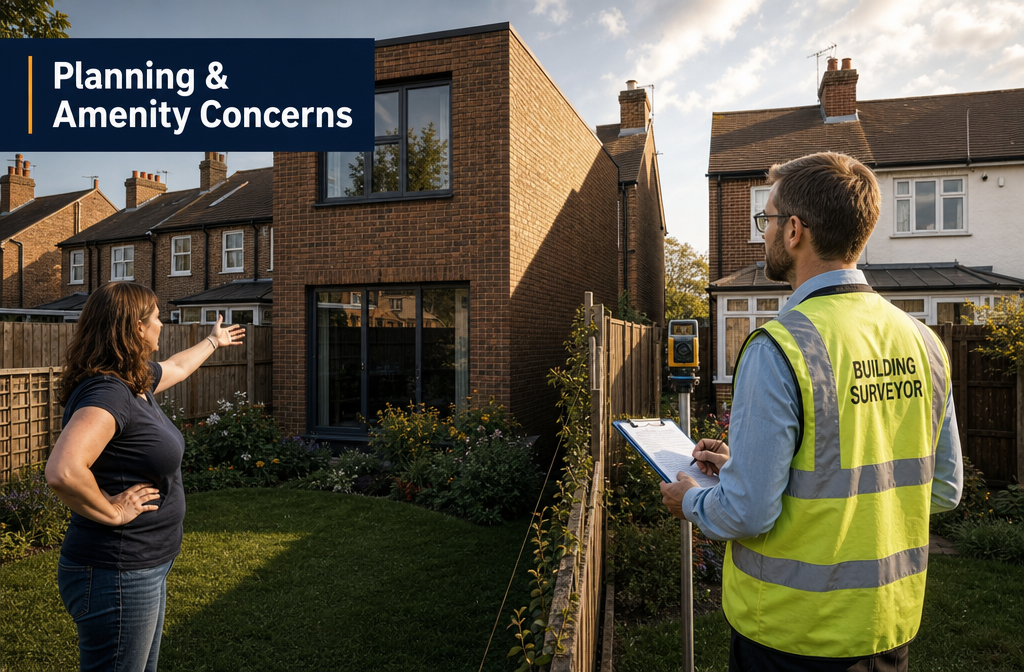
When a neighbour submits a planning application for an extension, affected neighbours typically have 21 days to submit representations. A surveyor's report prepared within this window — covering daylight, sunlight, overlooking, and overbearing impact — gives the LPA technical substance to weigh against the applicant's drawings. Without it, objections risk being dismissed as subjective concerns.
If permission is granted against a well-evidenced objection, the report can support a planning appeal or, in extreme cases, a judicial review challenge.
Under the Party Wall Act
A party wall agreement focuses on protecting both parties' structures during construction. However, the surveyor preparing the Award may also note pre-existing conditions and agree protective measures. A separate building surveyor's report on amenity impact sits alongside this process — addressing concerns that the Party Wall Act was never designed to cover.
For loft conversions specifically, the interaction between party wall obligations and overlooking concerns is particularly complex — see the guidance on loft conversions and party wall obligations for more detail.
In Mediation and Negotiation
Many neighbour disputes are resolved through mediation — a structured negotiation facilitated by a neutral third party. A surveyor's report gives both sides a shared factual basis from which to negotiate. When both parties can see the same measurements and calculations, the conversation shifts from "your extension ruins my garden" to "the VSC reduction of 28% exceeds the BRE guideline threshold of 20% — what design modifications would bring it within acceptable limits?"
This is a far more productive conversation [7].
In Civil Litigation (Rights to Light)
Where a right to light claim is pursued, the surveyor's technical evidence — particularly VSC and NSL calculations — forms the core of the claimant's case. Courts have consistently relied on BRE methodology in these cases [4]. An RICS-accredited surveyor with experience in rights to light matters is essential here; this is specialist work.
Choosing the Right Surveyor for Neighbour Disputes
Not every surveyor is equally suited to this type of work. The following criteria matter:
✅ RICS Accreditation
A surveyor accredited by the Royal Institution of Chartered Surveyors (RICS) is bound by professional standards and a code of conduct. Their reports carry institutional credibility. Learn more about why RICS chartered building surveyors matter for property matters.
✅ Relevant Experience
Look for a surveyor with specific experience in:
- Daylight and sunlight assessments
- Overlooking and privacy analysis
- Party wall matters
- Expert witness work (if litigation is possible)
✅ Independence
If the report may be used in planning, mediation, or court proceedings, the surveyor must be genuinely independent — not connected to either party or to the contractor who built the extension.
✅ Clear Methodology
A credible report sets out its methodology explicitly. It should reference BRE guidelines, relevant planning policy, and any RICS guidance documents used.
For those in London and the South East, local expertise matters — surveyors familiar with specific borough planning policies will produce more targeted reports. Specialist teams operate across North London, Central London, Islington, and Enfield, among many other locations.
Common Scenarios Where a Surveyor's Report Makes the Difference
Here are the situations where professional surveying input most commonly shifts the outcome of a neighbour dispute:
- 🏗️ Extension built under PD rights that appears to overshadow a neighbouring kitchen — no planning process available, but a surveyor's report supports a rights to light or nuisance claim
- 📐 Disputed boundary position where a new wall appears to sit on or over the legal boundary — a boundary survey resolves the factual question [5][8]
- 🪟 New first-floor windows that directly overlook a neighbour's bedroom — surveyor documents sightlines and separation distances for a planning objection or appeal
- 🌳 Two-storey rear extension that the LPA approved but which demonstrably reduces daylight below BRE thresholds — expert witness report supports an appeal
- 🔨 Damage to neighbouring property during construction — a pre-construction schedule of condition report (or lack of one) determines liability [1]
Conclusion: Taking the Right Steps in 2026
Neighbour disputes over extensions and overlooking are rarely simple — but they are almost always resolvable when the right technical evidence is on the table. A building surveyor's report does not replace planning law, the Party Wall Act, or private rights to light — it provides the objective, measurable evidence that makes each of those processes work more effectively.
Actionable Next Steps 🎯
- Act early. Commission a surveyor's report as soon as a concerning planning application is submitted — or as soon as works begin without notice.
- Identify the correct framework. Determine whether the concern is a planning matter, a party wall matter, or a private rights issue — or all three. Each may need a different professional response.
- Choose an RICS-accredited surveyor with specific experience in daylight, sunlight, and overlooking assessments.
- Consider a schedule of condition report before any neighbouring works begin — it protects both parties.
- Use the report in mediation first. Most disputes settle before reaching court when both sides have access to the same technical evidence.
- Seek specialist advice if rights to light may be engaged — this is a complex area where early legal and surveying input is essential [4].
For a professional assessment of how a building surveyor's report could support your specific situation, get a quote from a qualified chartered surveyor and take the first step toward a resolution grounded in evidence, not emotion.
References
[1] Extension Wall Built Too Close – https://www.property118.com/extension-wall-built-too-close/
[2] What UK Law Says Your Rights Are – https://www.mirror.co.uk/news/uk-news/what-uk-law-says-your-37145232
[4] Let There Be Light: New Guidance For Homeowners Left In The Shadows – https://www.rics.org/news-insights/let-there-be-light-new-guidance-for-homeowners-left-in-the-shadows
[5] Boundary Survey – https://arbtech.co.uk/boundary-survey/
[6] How Close Can My Neighbour Build To My Fence – https://wimbledonsurveyors.com/how-close-can-my-neighbour-build-to-my-fence/
[7] Why Surveying Is Critical In Renovations And Extensions – https://precisionsurv.co.uk/why-surveying-is-critical-in-renovations-and-extensions/
[8] Land Boundary Seems Off Should I Bring It Up – https://www.reddit.com/r/AskUK/comments/1rhwqd4/land_boundary_seems_off_should_i_bring_it_up_to/